


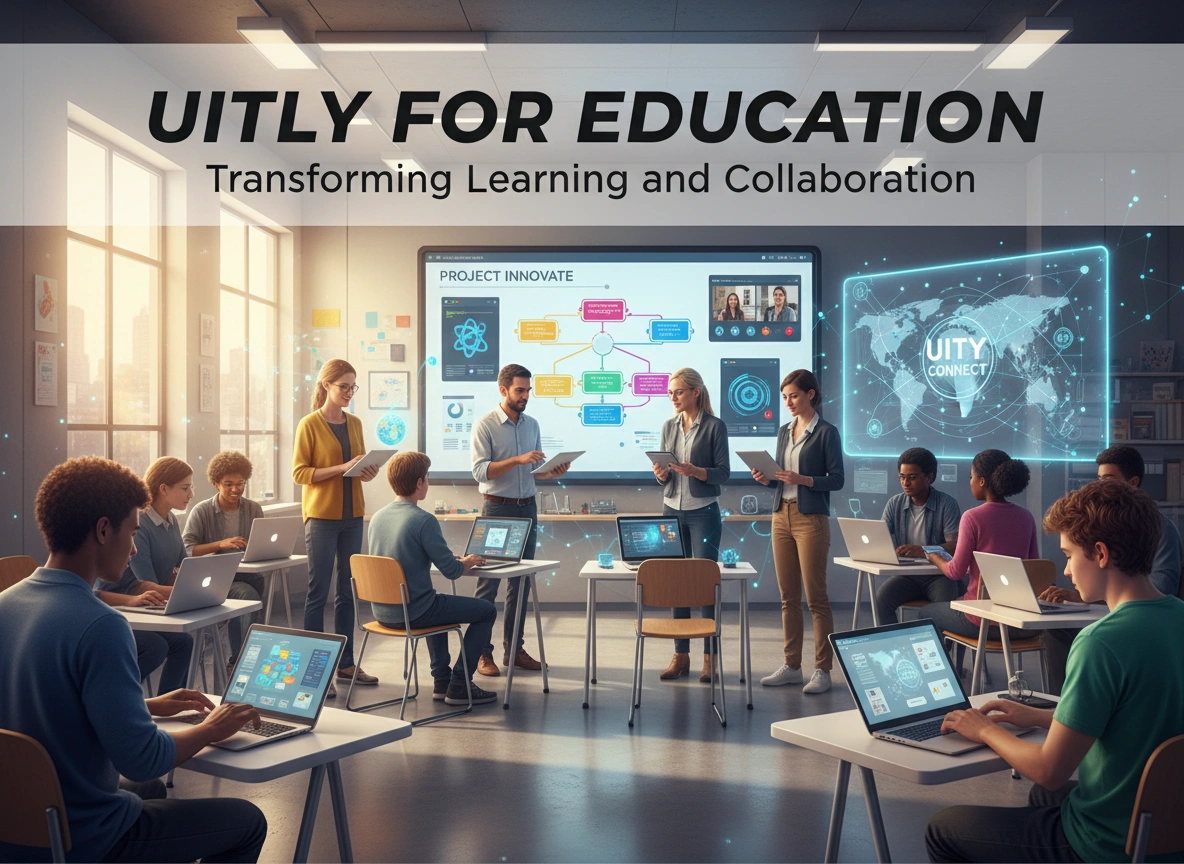
The traditional classroom is no longer the sole venue for academic growth. Education has moved beyond four walls and a chalkboard, evolving into a dynamic ecosystem where digital tools bridge gaps between students, teachers, and resources. Among the platforms leading this shift is Uitly, a solution designed to reshape how educational institutions approach teaching and collaboration.
Uitly isn’t just another learning management system (LMS) or video conferencing tool. It represents a holistic approach to the digital campus, integrating communication, project management, and personalized learning into a cohesive environment. For educators struggling with fragmented tech stacks and students craving more interactive learning experiences, Uitly offers a path forward that prioritizes engagement and efficiency.
In this article, we will explore how Uitly is revolutionizing the educational landscape, examine its core features, and discuss the tangible impact it has on the modern learning experience.
The Problem with Fragmented Educational Tech
Before diving into the solution, we must understand the challenge. Many schools and universities currently operate using a “Frankenstein” approach to technology. Teachers might use one platform for grading, another for video lectures, a third for messaging, and a fourth for file sharing.
This fragmentation leads to:
- Cognitive Overload: Students spend more energy navigating tools than learning the material.
- Data Silos: Educators cannot easily track student progress across different platforms.
- Communication Breakdown: Important announcements get lost in email threads or disparate chat apps.
Uitly addresses these pain points by centralizing the educational experience. It serves as a unified hub where the administrative and pedagogical aspects of schooling converge seamlessly.
Core Features Redefining the Virtual Classroom
Uitly distinguishes itself through a suite of features tailored specifically for academic environments. It moves beyond generic business tools to offer functionality that respects the unique dynamics of a student-teacher relationship.
1. The Interactive Virtual Classroom
Static video calls are often disengaging. Uitly’s virtual classroom environment includes integrated whiteboards, real-time polling, and breakout rooms that are intuitive to set up. Unlike standard corporate meeting software, these tools are designed for pedagogical flow. Teachers can seamlessly switch from a lecture mode to a collaborative workshop mode without losing class momentum.
2. Centralized Resource Hubs
Instead of burying syllabi and reading materials in obscure folders, Uitly uses visual Resource Hubs. These are customizable spaces where educators can curate multimedia content—videos, PDFs, interactive quizzes, and external links—organized by topic or week. This visual organization helps students mentally map the course structure, making it easier to retrieve information when studying for exams.
3. Smart Collaboration Spaces
Group projects are notoriously difficult to manage remotely. Uitly provides dedicated collaboration spaces where student groups can chat, share files, and co-edit documents in real-time. Crucially, educators have oversight capabilities, allowing them to drop in, offer guidance, and track individual contributions to ensure fair grading.
Empowering Educators: Efficiency and Insight
For teachers and professors, administrative burdens often detract from teaching time. Uitly aims to reverse this trend by automating routine tasks and providing deeper insights into student performance.
Streamlined Assessment and Feedback
Grading is often the most time-consuming part of an educator’s job. Uitly integrates assessment tools that allow for varied submission types, from written essays to video presentations. The platform’s feedback mechanism supports annotated grading, voice notes, and rubric-based assessments. This variety ensures that feedback is not just a letter grade but a constructive dialogue that helps the student improve.
Data-Driven Insights
One of Uitly’s most powerful aspects is its analytics engine. It goes beyond simple attendance tracking. The platform analyzes engagement metrics, such as:
- Time spent on specific resources.
- Participation levels in discussion forums.
- Quiz performance trends over time.
For example, if an entire class struggles with a specific module on “Introduction to Calculus,” the analytics dashboard will flag this anomaly. The instructor can then intervene early, perhaps by scheduling a review session or uploading supplementary explainer videos, rather than waiting until the midterm exam to discover the gap in understanding.
Enhancing the Student Experience: Personalization and Agency
Students today are digital natives who expect their educational tools to be as responsive and intuitive as the apps they use in their personal lives. Uitly meets these expectations by putting the learner in the driver’s seat.
Personalized Learning Pathways
One size rarely fits all in education. Uitly supports adaptive learning pathways where content release can be triggered by performance. If a student aces a pre-assessment, they might skip introductory material and move straight to advanced concepts. Conversely, a student who struggles might automatically receive additional practice exercises before moving forward. This personalization ensures that students remain challenged but not overwhelmed.
Community and Peer Support
Isolation is a significant risk in digital or hybrid learning. Uitly fosters community through structured social features. Discussion boards are gamified to encourage quality contributions, and peer-review systems allow students to critique and learn from each other’s work. By formalizing these interactions, the platform builds a sense of belonging that is vital for academic retention.
Real-World Use Cases: Uitly in Action
To truly understand Uitly’s impact, let’s look at specific scenarios where the platform transforms the educational process.
Scenario A: The Hybrid Science Lab
In a university biology course, lab work is essential. However, limited physical space means students rotate between in-person and remote weeks.
- Before Uitly: Remote students watched a passive livestream of the lab, often feeling disconnected.
- With Uitly: The professor uses Uitly to pair a remote student with an in-person partner. They communicate via the platform’s low-latency video link. The remote student records data directly into the shared Uitly workspace while the in-person student manipulates the equipment. They analyze the results together in real-time. The platform bridges the physical gap, ensuring both students actively participate in the experiment.
Scenario B: The Cross-Border Cultural Exchange
A high school language department wants to connect students learning Spanish with peers in a partner school in Mexico.
- Before Uitly: Logistical nightmares involving time zones and incompatible software made these exchanges rare and chaotic.
- With Uitly: The schools set up a joint “Global Classroom” within Uitly. The platform handles time zone conversions automatically. Students are assigned to mixed small groups for a semester-long project on cultural traditions. They use the asynchronous video messaging feature to communicate across time zones, and the real-time translation tools help bridge minor vocabulary gaps without hindering the flow of conversation.
Overcoming Implementation Challenges
Adopting a new platform like Uitly does require a strategic approach. Institutions must invest in training to ensure faculty are comfortable with the advanced features. Resistance to change is natural, but Uitly mitigates this through an intuitive interface that mimics familiar social media and productivity apps.
Furthermore, equity is a critical consideration. Uitly is built with accessibility in mind, featuring screen reader compatibility and low-bandwidth modes for students with unstable internet connections. This commitment ensures that the digital transformation of education does not leave marginalized students behind.
The Future of Learning with Uitly
As we look toward the future, the role of technology in education will only grow. The distinction between “online learning” and “classroom learning” is fading; soon, there will just be “learning,” supported by a robust digital infrastructure.
Uitly is positioned at the forefront of this evolution. By prioritizing collaboration, data insight, and user experience, it empowers institutions to deliver education that is resilient, inclusive, and effective. It transforms the educator from a lecturer into a facilitator and the student from a passive recipient into an active explorer.
For educational leaders looking to modernize their institutions, the question is no longer whether to adopt digital tools, but which tools align best with their pedagogical goals. Uitly offers a compelling answer, proving that when technology is designed with empathy for the learner, it does more than just digitize the classroom—it humanizes it.
